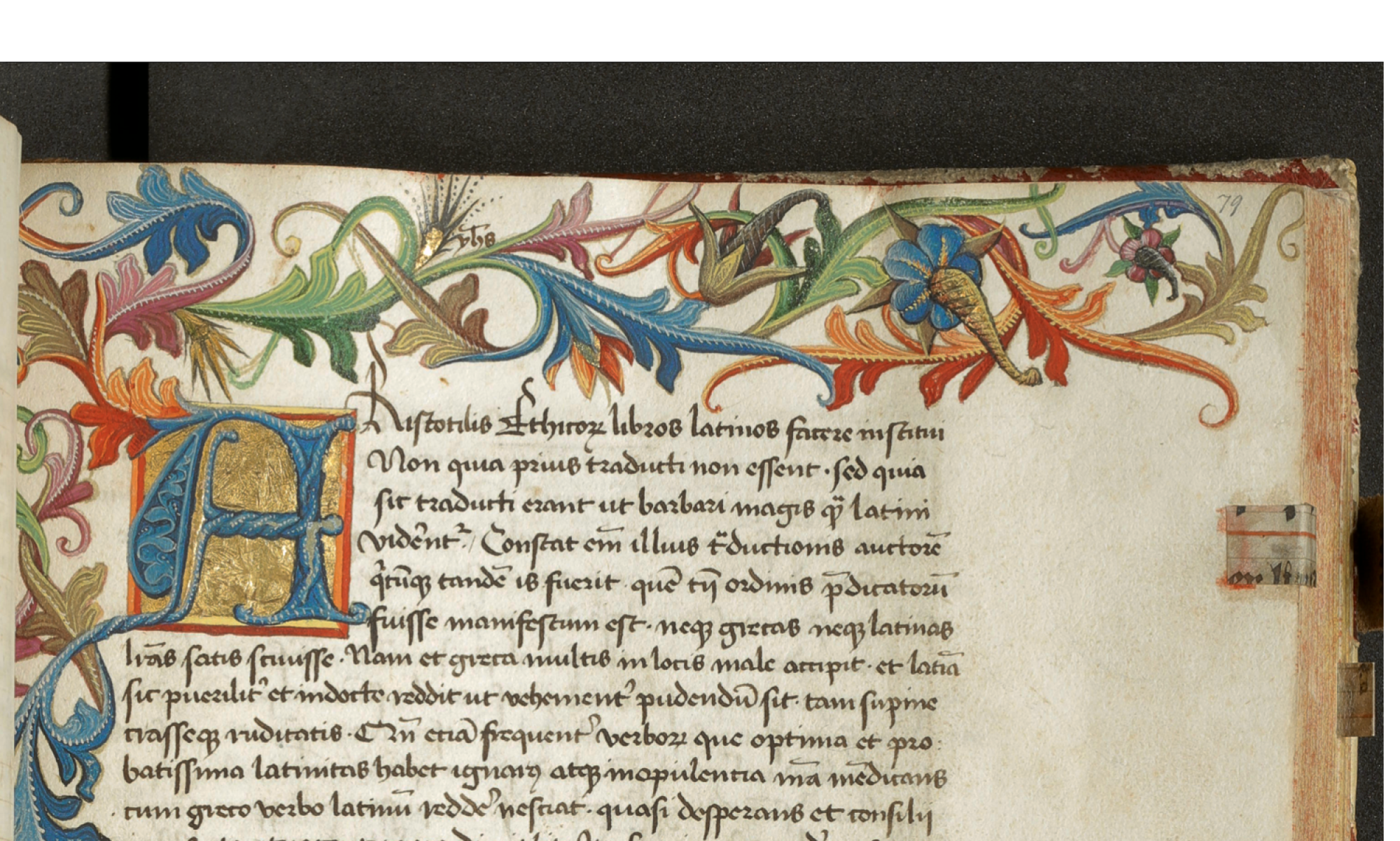
Nicholas of Cusa as a Reader of Plato and Aristotle (DFG project)
The manicula project explores the corpus of Platonic and Aristotelian manuscripts which Nicholas of Cusa possessed and read. The aim of the project is to produce a critical edition of Cusanus’ glosses and marginal notes to the Latin translations of Plato’s and Aristotle’s works and to investigate Cusanus’ reading practices in the broader context of the 15ᵗʰ-century reception of Plato and Aristotle. The manicula project will also scrutinize, from an innovative perspective, Cusanus’ relations to the intellectual currents of his time and to competing 15ᵗʰ-century models of appropriation of ancient philosophy. At the same time, by studying the specific genre of the marginalia, the project aims to explore Cusanus’ working methods as a reader and writer, his ideal of the library, and the personal and intellectual network through which he came into contact with books and doctrines that influenced his philosophy. The project, which officially started in August 2023, is based at the University of Siegen and is funded by the Deutsche Forschungsgemeinschaft (DFG). It is conceived as a starting point for a relaunch and re-conception of the critical edition of all Cusanus’ marginalia, which began in 1941 with the first volume of the series Cusanus-Texte. III. Marginalien (Winter Verlag, Heidelberg) and has remained unfinished to date.
Recent News
19 August 2026
Out now: Mario Meliadò, Die Cusanus-Bibliothek als Konstellation: Zum Lese- und Schreibideal im Gelehrtenkreis des Nikolaus von Kues. Part of Konstellationen, Andreas Speer and Lars Reuke (eds.), De Gruyter, Berlin/Boston, 2026 (pp. 112–138).

17 August 2026
Out now: Luca Burzelli and Mario Meliadò, “The Aristotelian Library of Nicholas of Cusa: The Case of the Metaphysica”. Part of The Medieval Aristotle. Studies Celebrating Half a Century of Aristoteles Latinus in Leuven, 1973–2023, Nena Bobovnik, Clelia Crialesi and Lisa Devriese (eds.), Leuven University Press, Leuven, 2026, (pp. 217–239).